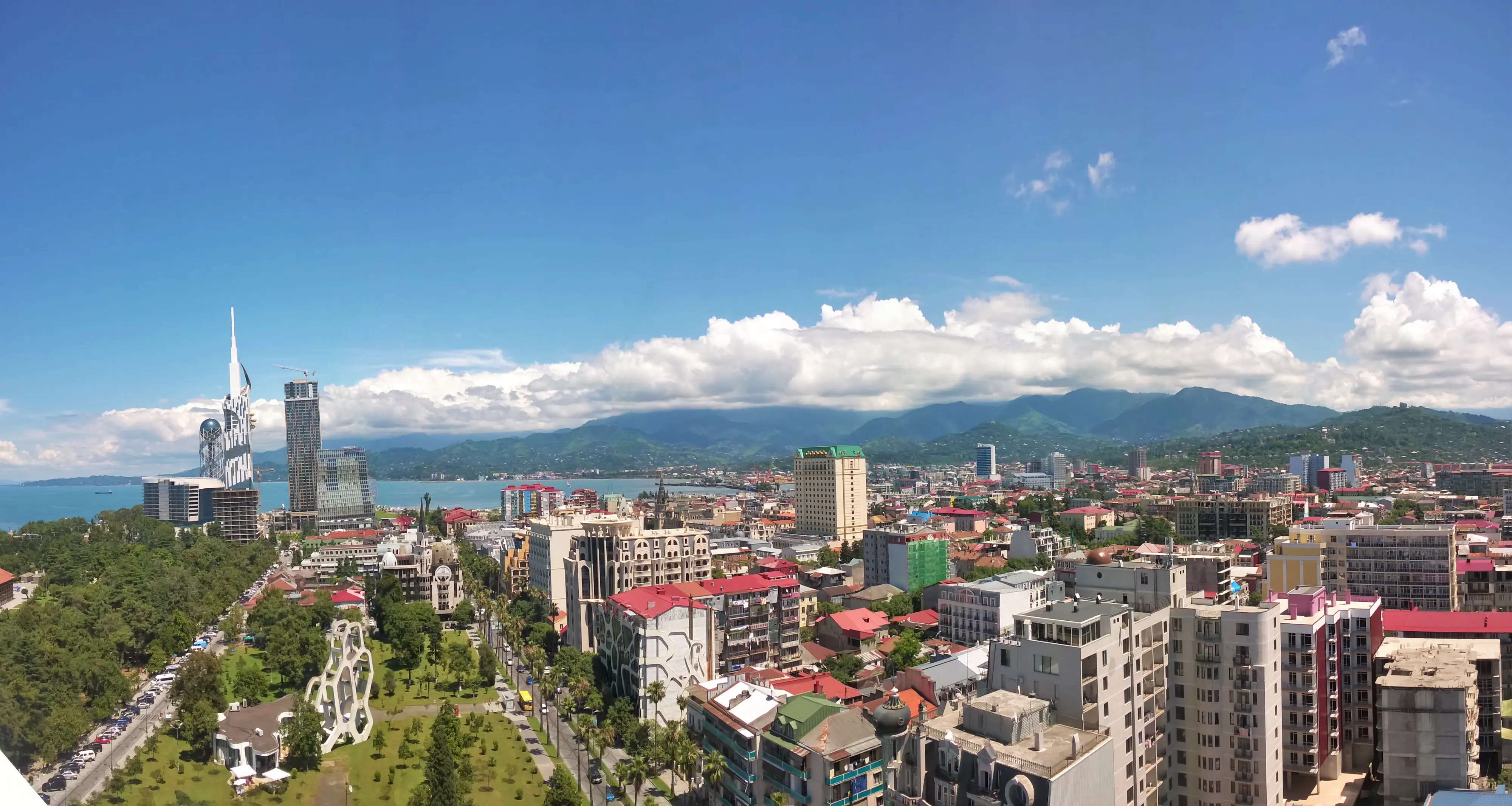
In a sales presentation, Batumi can look like one continuous market: sea, towers, pools and panoramic glass. At street level, it breaks into very different products.
Old Batumi sells scarcity and urban life. Alley of Heroes offers modern scale. New Boulevard provides volume and access to the coast. Gonio and Kvariati operate as resort markets. Makhinjauri is shaped by landscape. The inner districts belong to the year-round city.
Every property may be marketed as “Batumi real estate”. The underlying demand is not the same.
Market · June 2026
The market on one page
Average primary-market prices for completed apartments differed substantially across the city in June 2026:
These figures describe direction, not the fair value of a particular apartment. An average combines different projects, stages, views, operating models and levels of quality. Transaction volume does not automatically make every unit liquid.
01 · There is no best district
Start with the buyer, not the map.
A district cannot be judged without knowing the buyer.
A permanent resident needs practical routes, shops, schools, parking and a functioning neighbourhood. A short-stay guest needs a clear reason to choose that location. A long-term tenant values year-round convenience. A future buyer needs scarcity and a convincing alternative to the competing stock.
One apartment rarely optimises every scenario. Define the intended use first. Then find the address where that demand already exists—or has credible reasons to develop.
The address creates demand. The apartment only participates in it.
02 · Old Batumi
Scarcity rather than scale
Old Batumi is the most expensive of the city’s major submarkets. Buyers are paying for more than floor area: they are buying the ability to walk through an established city, close to the boulevard, squares, restaurants and cultural landmarks.
Limited development space supports scarcity, but the district’s premium does not guarantee the quality of an individual property.
One street may be residential and quiet; the next may remain noisy late into the night. A new building can still face an ageing property, a difficult courtyard or poor vehicle access. In historic stock, structure, utilities, common areas and the legal status of alterations require particular attention.
Old Batumi suits buyers seeking urban life, a scarce address and a broad future resale audience. Here, the exact street and building matter more than the district label.
03 · Alley of Heroes
A new centre still taking shape
Alley of Heroes has become one of Batumi’s principal development zones. It is vertical, contemporary and mixed-use: residential towers sit alongside hotels, retail, offices and major urban infrastructure.
Its position can combine access to the centre, the coast and everyday services. Demand therefore does not have to depend entirely on summer tourism.
The area is still changing. An open view may be temporary, a neighbouring plot may receive another tower and traffic patterns may become denser. Within the building, lift capacity, parking, service charges and the balance between residential and hotel use are essential.
Alley of Heroes works for buyers who want a modern city product. Height and panorama add value only when the building functions properly and the unit can stand apart from its competition.
04 · New Boulevard
More choice also means more competition
New Boulevard is Batumi’s largest segment by transaction volume. It contains almost every version of the new city, from compact studios to family apartments and large aparthotel developments.
For that reason, “New Boulevard” is not a sufficiently precise address. The first line, an internal block and a site closer to the airport can produce very different routes, noise levels, surroundings, views and rental demand.
A large pipeline creates accessible entry points, but it also creates competition. Hundreds of similar studios may reach the rental and resale markets at the same time.
A strong unit needs something that cannot be copied easily: a protected view, an efficient plan, a genuine separate bedroom, an unusual size, capable management or a particularly convenient position.
Proximity to the sea is a feature. It is not an investment strategy.
05 · Gonio and Kvariati
Paying today for tomorrow’s resort
Gonio and Kvariati offer a different proposition: lower urban density, a relationship between sea and mountains, and a more explicitly resort-led environment. Their average price is already above New Boulevard, despite a much smaller transaction base.
Buyers are often paying for infrastructure and destination value that are still being developed. The outlook for the wider location must therefore be separated from the promises made by an individual project.
Check the actual route to the beach, site elevation, road access, future phases, operating model and what remains open beyond the peak season. A dramatic view cannot correct poor access or weak management.
These areas can suit personal resort use, premium hospitality products and longer-horizon investment. They should not be underwritten as ordinary city apartments.
06 · Makhinjauri and Green Cape
Landscape is both an asset and a constraint
Batumi’s northern direction attracts buyers through greenery, elevation and wider views. It can offer a quieter proposition than the high-rise core.
Yet distance measured in a straight line says little about daily convenience. Slope, access roads, the railway, acoustics, drainage and the distance to everyday services can completely change the experience of an address.
Makhinjauri and Green Cape should not be treated automatically as one product. Neighbouring plots can differ sharply in elevation, access and future surroundings. The Galt & Taggart figures refer to its Makhinjauri category; a Green Cape property still requires its own assessment.
This part of the coast suits buyers who place landscape and privacy above central-city logistics.
07 · The inner areas
A year-round city without the postcard
A liquid apartment does not always need to be beside the sea.
Demand in the inner districts is more likely to come from people who genuinely live in Batumi: families, local employees, students and long-term tenants. Transport, shops, schools, street quality and the condition of the building matter more than a resort narrative.
These apartments may cost less and produce fewer dramatic photographs. Their economics can nevertheless be more resilient when the entry price is sensible and year-round demand is real.
The principal risk is a narrower international resale audience. A functional layout, a strong local environment and disciplined pricing must compensate for it.
08 · Address audit
Audit the address before selecting the unit
Before discussing the floor, discount or instalment plan, check seven things:
The real route
Walk to the beach, shops and transport instead of relying on a map radius.
Different times
Visit in the morning, evening, at the weekend and after rain.
Neighbouring plots
Review the cadastral map and any undeveloped land in front of the windows.
The demand driver
Identify who will use the property outside the peak season—and why.
Direct competition
Count similar units in the building and nearby projects.
Operations
Compare service charges, management, lifts, parking and owner-use restrictions.
The exit buyer
Define who may buy this exact apartment in three to five years.
Plots and surrounding land can be reviewed initially through the official NAPR Maps portal. Transaction documents require separate professional review.
The BUC view
Address first. Building second. Apartment third.
No part of Batumi is always better than the rest. There are addresses that match a specific objective, and addresses supported mainly by an attractive sales story.
The decision should not begin with “Where will prices rise fastest?” A more useful question is: why will the next tenant or buyer choose this location when dozens of alternatives are available?
Choose the type of demand first. Then the address, building, individual unit and purchase terms—in that order.
That is the point at which property stops being an image in a presentation and becomes an intelligible asset.
This is general information, not individual legal, tax or investment advice. Data checked on 14 September 2026.