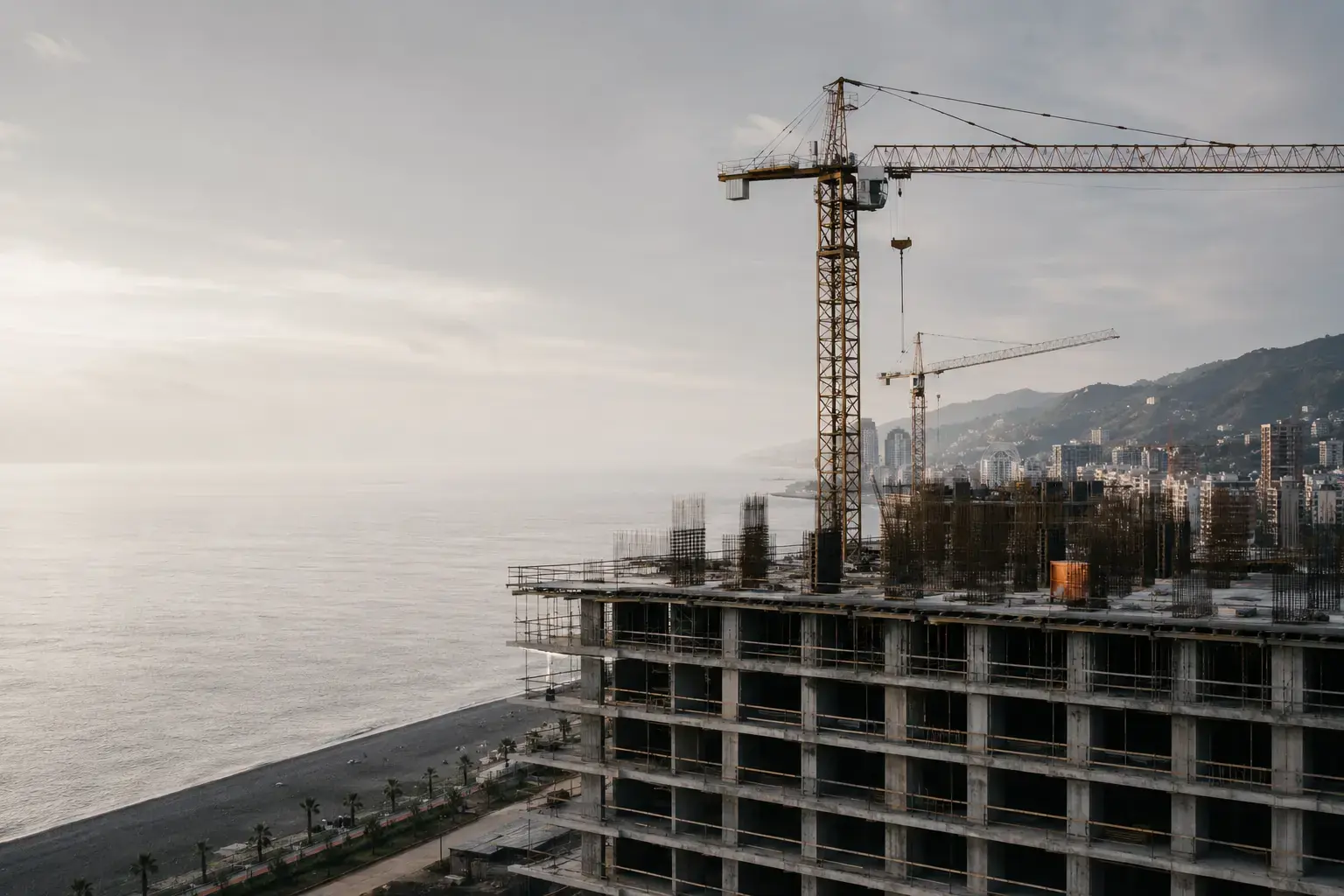
A render shows the ending: lights on, pool full, lobby immaculate. A construction site has none of that yet. It has land, a permit, a contract and a company promising to deliver the rest.
That chain of promises is what you are buying. The square metres come later.
In June 2026, the average asking price for completed primary-market property in Batumi reached $1,960 per square metre, versus $1,497 on the secondary market. A new project may deserve that premium for its design, payment plan or management. But the premium makes sense only when every promise can be traced to a document, a responsible party and a deadline.
So the first question is not, “What discount can I get?” It is, “What exists today, and where is it recorded?”
If you only have one minute
Start with the cadastral code.
It connects the sales story to a specific plot and registry record.
Identify the seller.
The project brand, landowner and contract party may be different companies.
Match the render to the permit.
Not everything pictured is necessarily approved or included in the current phase.
Treat the contract as the product.
If a promise is absent from the text, do not price it into the deal.
Run the weak case.
A delay, softer rent and higher running costs should not break the investment.
Until the apartment exists, the documents are the apartment.
01
Begin with what exists today
Ask for a fresh extract for the land and the cadastral plan. Check the owner, plot size and designated use, then look for mortgages, seizures, easements and other restrictions. In Georgia, this information sits with the National Agency of Public Registry.
Now look at the company named in the contract. Who can sign for it? Who receives your money? Who owns the land, and who holds the permit? Different entities are not automatically a problem, but their rights must connect on paper — not only in a sales manager’s explanation.
Check the seller in the Business Registry and ask for a list of genuinely completed projects. Ten years in business and ten announced towers are not the same as buildings that have been delivered and commissioned.
A mortgage over the land is not automatically bad news; it may reflect normal project finance. What matters is the release mechanism: how and when will your unit be discharged from the bank’s security?
Pre-registration of a future right may strengthen a buyer’s position, but its value depends on the contract and how precisely the unit is described. Ask independent Georgian counsel to confirm whether it works for your deal and what happens after termination or delay.

A good address begins with a cadastral code.
02
The permit matters more than the render
Ask for the current construction permit, approved plans and every amendment. Match the cadastral code, permit holder, building use, height and parameters to the phase containing your unit. Under Georgia’s construction code, works require the applicable permit or statutory notification; the route depends on the building class.
Pay particular attention to amenities. The pool, promenade, retail gallery or next tower may belong to a later phase. Find out what is approved now, who must build it and by when.
Completion is not one date
Physical completion, commissioning, registration of the individual unit, handover of keys and the start of rental operations are separate events. The contract should name the event that counts as delivery. Without that, the date in the brochure does very little work.
The render shows the idea. The permit shows what may be built. The contract shows what must be delivered to you.
03
The contract is the project’s main product
Off-plan, you are not buying a finished object. You are buying an obligation. The contract should answer these questions without help from the sales desk:
What exactly is the unit?
Number, floor, area, orientation, balcony, plan and permitted area variance.
What is included?
Finish, furniture, appliances, engineering and common areas — in schedules, not just a brochure.
When is it due?
A clear delivery event, a limit on extensions and consequences for delay.
How do you pay?
Full schedule, currency, bank costs, final instalment and refund rules.
When do you get title?
Registration mechanics, release of bank security and the seller’s required documents.
Can you exit earlier?
Assignment rights, fees, developer consent and resale restrictions.
What may the seller change?
Area, view, materials and amenities should not be open to unlimited revision.
Compare remedies on both sides. If the buyer is fined for every late day while the seller can delay for a year with little consequence, the balance is clear. Also check which language version prevails.
Anything missing from the contract remains advertising.
04
Brand, operator and developer are different roles
A familiar logo may help demand, but it does not tell you who builds, who manages or who owes duties to the buyer. A brand may set standards without operating the property. An operator may arrive only after commissioning. In some cases, the agreement is not yet signed.
Ask for written evidence of the relationship: the legal entity, status of the agreement, term, scope and exit provisions. Then examine the rental pool, operator share, service charges, furniture reserve, owner-use rules and reporting.
A “guaranteed return” needs a named payer. Ask who pays, from what source, for how long, under which exceptions and with what security. A promise from a thinly capitalised project company is not the same as a bank guarantee.
A logo may support demand. It does not replace a permit, balance sheet or contract.
05
Count every cost — and one bad year
The price list is only the first line. Add registration and legal fees, banking and currency costs, fit-out or furnishing, service activation, building charges before occupancy, management and tax. An instalment plan spreads payments through time; it does not remove cost or risk.
Now rerun the deal in a weaker scenario:
Commissioning is 12 months late.
Payments continue; rent does not.
Achieved rent is 15% below the pitch.
Look at the net figure after management and operating costs.
Occupancy is 10 percentage points lower.
In a seasonal market, the effect is immediate.
Costs are 20% higher and the resale price is flat.
Include commission, transfer costs and time on the market.
If the numbers still work, the project may survive contact with reality. If profit requires on-time delivery, premium rent, near-full occupancy and capital growth all at once, you are looking at a sales case, not an investment case.
BUC’s rental model uses total capital invested and separates gross revenue from the result after vacancy, management, platforms and fixed costs.
06
Choose a unit, not a project name
Even in a strong building, not every apartment is a strong asset. Two studios of the same size may perform very differently because of view, noise, room depth, columns, balcony or lift access.
View.
Check neighbouring plots. Empty land today does not protect the view tomorrow.
Plan.
Focus on usable space, room width, storage and whether the sleeping arrangement actually works.
Floor and lifts.
Height adds value only when lift capacity and maintenance make it practical.
Competition.
Hundreds of similar studios may reach the rental and resale market together.
Exit.
Who will buy this exact unit from you in three to five years, and why choose it over the alternatives?
The market may rise. The next buyer will still choose a specific apartment.
07
Know when to pause
One awkward point does not always kill a deal. Several together mean you should stop paying until the answers arrive in writing.
No cadastral code or fresh land extract.
The project cannot be tied to a legal asset.
Sales are active while the permit is “in progress”.
It is unclear what is approved and what may still change.
The seller is not connected to the land or permit.
The link exists only in conversation.
A non-refundable reservation is demanded before documents.
Due diligence begins after your money is exposed.
The deadline is in the brochure, not the contract.
Or the seller has an almost unlimited extension.
Penalties apply only to the buyer.
Seller delay brings no comparable remedy or exit.
Return is promised without a model or guarantor.
The payer and exceptions are unclear.
A large final payment falls due before commissioning.
Most of the price leaves before the key event.
The minimum file before payment
Land extract and cadastral plan.
Owner, designated use and encumbrances.
Seller’s company extract.
Status, representative and restrictions.
Current permit and approved plan.
For the phase containing your unit.
Every draft agreement.
Reservation, purchase, registration, management and rental, where relevant.
Unit plan and specification.
Area, orientation, finish and equipment.
Full payment and cost model.
Capital to launch, fees and a conservative income case.
A short note from independent Georgian counsel.
Specific risks and proposed amendments, not a generic summary.
BUC
The BUC view
Buying off-plan can offer a lower entry price, first choice of units and a useful payment schedule. Risk does not make the deal bad. It simply needs to be visible in the price, documents and terms.
The mistake is not buying a promise. It is paying for that promise as though it had already been delivered.
A strong purchase survives five tests: the land and permit are clear; the responsible company is identified; the contract defines delivery and delay; the economics work without a perfect scenario; and the exact unit remains liquid.
A beautiful project attracts attention. A specific project survives scrutiny.